
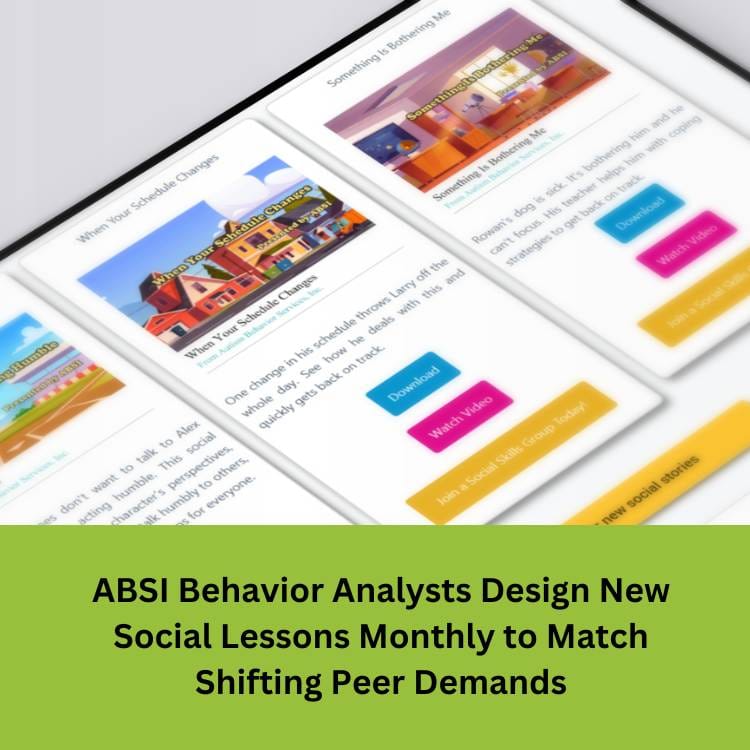
Most social skills programs operate from a fixed curriculum, often developed months or even years before a child ever enters the room. By the time a lesson on playground conflict reaches a third grader, that child may already be navigating middle school group chat dynamics.Autism Behavior Services Inc. takes a different approach. Across all ABSI social groups: Giggle Group (toddler–preschool), Let’s L.A.F.F. (elementary, middle, and high school), and Adult Group, curriculum is designed monthly by a dedicated team of board-certified behavior analysts. Every 30 days, new lessons, topics, and structured activities are developed and calibrated specifically to the developmental levels, ages, and emerging needs of current participants.
# Press Release
Bakersfield, CA – 24 February 2026
ABSI Behavior Analysts Design New Social Lessons Monthly to Match Shifting Peer Demands
Flexible curriculum model allows real-time response to evolving social challenges faced by children, teens, and adults in group settings
“Social demands shift rapidly based on peer composition, school environment, and cultural context. A curriculum written in September cannot anticipate what a child will need in February.”
— Andrew Patterson, President of ABSI

The responsive model means that when multiple elementary school-aged clients independently demonstrate difficulty with peer conflict during unstructured time, the following month’s Let’s L.A.F.F. curriculum can be adjusted to emphasize conflict resolution scripts and joint problem-solving. When adolescent group members present with anxiety about digital social communication (group chat dynamics, text interpretation, online boundaries) facilitators can introduce curriculum specifically addressing those environments.
“The assumption underlying fixed-year curricula is that social development follows a predictable, linear path and that all children of a given age face identical challenges,” said Andrew Patterson, President of ABSI. “Our experience with thousands of clients over 15 years tells us this is not accurate. Social demands shift rapidly based on peer composition, school environment, and cultural context. A curriculum written in September cannot anticipate what a child will need in February. The only way to remain relevant is to build in real-time revision.”
“This is not anecdotal responsiveness,” Briana, a licensed behavior analyst at ABSI, explained. “Behavior analysts are present in every group, collecting real-time data on participant performance and identifying emerging skill deficits before they take root. When we see a pattern across multiple participants, we have the infrastructure to respond immediately. That is the difference between reactive and proactive clinical care.”
Giggle Group sessions incorporate songs, games, art, and play-based activities that foster sharing, cooperation, and communication; adjusted month to month based on the specific social milestones participating toddlers are approaching. Let’s L.A.F.F. groups for teens practice initiating conversations, maintaining friendships, and understanding social cues through role-playing and collaborative challenges that reflect the peer environments participants currently occupy. Adult Group members engage in guided conversations and community outings structured around the communication and self-advocacy goals most relevant to their daily lives.
“The generalization literature is unequivocal: skills taught in isolation do not reliably transfer to natural environments,” said Briana. “The closer the teaching context approximates the real-world context, the more likely transfer becomes. Monthly curriculum revision allows us to continuously narrow that gap.”
The institute’s clinical team meets monthly to review aggregate data across all groups, identifying broader trends that inform curriculum development. When multiple age cohorts demonstrate similar needs, such as increased difficulty with unstructured social time following pandemic disruptions. the team develops coordinated responses across groups while maintaining age-appropriate delivery.
“Families often ask whether their child will be ready for situations we cannot predict,” Patterson added. “Our answer is that we cannot predict every situation, but we can build a system that adapts as situations emerge. The goal is to maintain a perfect feedback loop between what participants need and what we teach.”
About Autism Behavior Services, Inc.
Autism Behavior Services Inc. provides applied behavior analysis consultation, social skills programming, and family support to autistic individuals across the lifespan. With groups serving toddlers through adults, ABSI is committed to responsive, respectful, and evidence-based care that meets clients where they are.
Social skills groups include Giggle Group (toddler–preschool), Let’s L.A.F.F. (elementary, middle, and high school), and Adult Group, with curriculum refreshed monthly by a team of board-certified behavior analysts.

For media inquiries or further information, please contact: [email protected] or 1-855-581-0100 ext. 115